
Efforts to reimagine child care are gaining momentum. Increasingly, using government funding to support child care is viewed as a public good that benefits all young children, families, and communities. Examples are emerging across the country:
- Montana recently passed bipartisan legislation that creates a dedicated fund for early childhood, which will help expand access to quality child care.
- New York is working to expand universal child care to families with 2-year-olds across the state.
- New Mexico recently became the first U.S. state to offer free, universal child care for all families, regardless of income, and now is codifying that program into law.
- Vermont already is implementing its universal child care model through a public-private partnership.
- Washington state is expanding its Pre-K program to serve an additional 10,000 children.
- Pima County in south-central Arizona expanded access to Pre-K for 3- and 4-year-olds for income-eligible children and families.
While these all represent positive and encouraging change, it will take more to broadly improve the birth-to-five early care and education system. The bigger challenge:
Today, there are at least eight government payers purchasing child care for families in each state (which we discuss in more detail later in this blog). Some funding flows from the federal government, while other funding flows from state and local governments. Each government payer has its own rationale, regulations, and reimbursement or per-pupil rate. This creates conflicting and confusing child care terminologies, regulations, credentialing expectations for practitioners, and varying reimbursement or per pupil rates for similar child experiences.
“In most states, the funding streams collectively are a tangled mess that are hard for families to navigate.”
—Elliot Regenstein
This overwhelming and inefficient bureaucracy creates an administrative burden that pulls child care funding away from children and disincentivizes businesses in this market from properly leveraging much-needed government funding. Too often, child care policy and funding decisions do not focus on, or name, what children are expected to experience. Few children are experiencing the Perry Preschool or Abecedarian models that have been historically used to make the case for investments in early childhood education.
This moment of increased visibility for child care is also challenging outdated mindsets and laying the foundation for a new era of child care policies.
This is a good time to pause, remember the “child” in child care, and ask:
- What experiences do children need to grow and develop?
- What child experiences do families want for their children?
- What types of child experiences should the government fund?
For the past five years, WeVision EarlyEd has provided space, resources, and tools to define the ideal child care system and demonstrate that the ideal is possible in the U.S. context — right now. This initiative is iterative and continues to be shaped by many perspectives, including the 21 WeVision EarlyEd Solutions Lab Sites established and funded by the Bainum Family Foundation across 11 states and D.C.
Many “what if?” questions are emerging from today’s headlines, learnings from Solutions Lab sites, and real-time feedback from the field.
“What we cannot imagine cannot come into being.”
—bell hooks
Three Ways to Reimagine the Child Care System by Remembering the “Child” in Child Care Policies
1. Be clear about the child experiences that are being funded.
Young children are always learning. How much they learn and what they learn is shaped by biology and their experiences within their family, community, and societal contexts. While this interplay is not a predictable “school readiness” formula, and each child is unique, child experiences matter. We must ask:
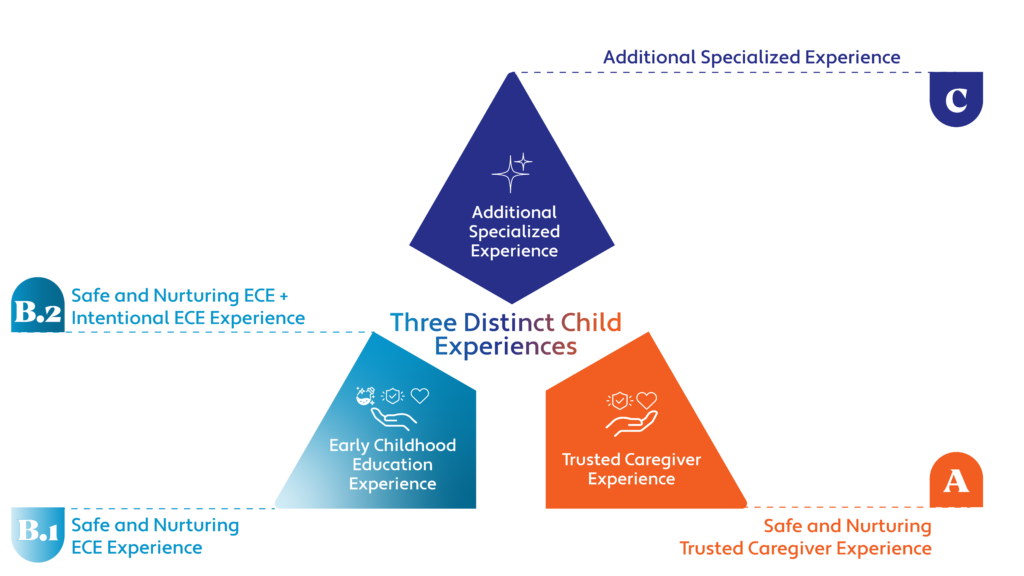
- What if the child care system is designed to deliver three clear and distinct categories of child experiences? What if each category is valued for the distinct child experience it provides?
- What if Trusted Caregivers and Early Childhood Educators, along with those who prepare and employ them, had greater clarity about their distinct roles and the specific child experiences they are responsible for delivering?
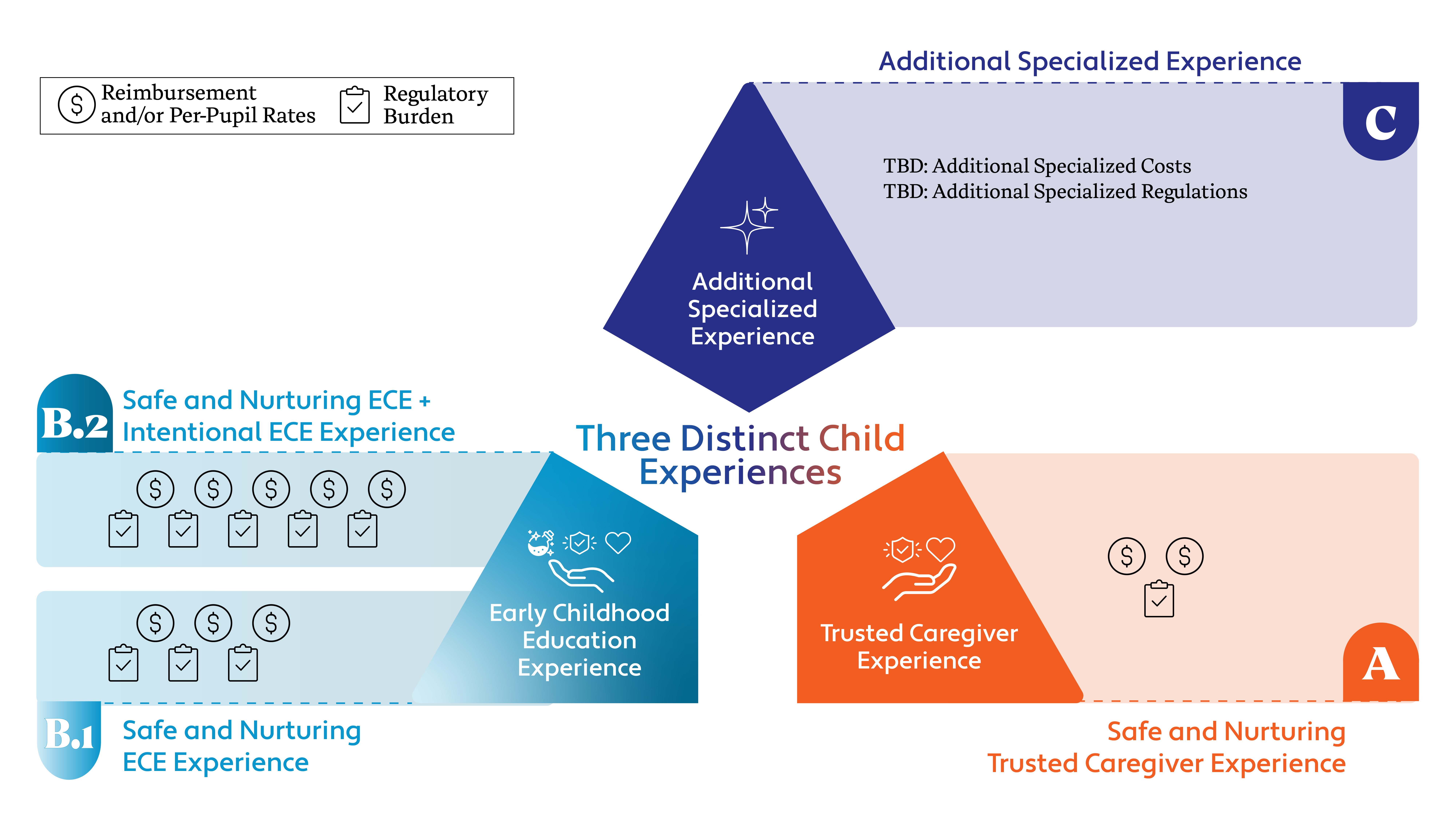
These experiences and roles come together in three distinct ways (categorized here as A, B, and C and represented in Figure 1 below).
A. Safe and Nurturing Trusted Caregiver Experiences:
Children are safe with the Trusted Caregivers who care for them and partner with their families (or are the families themselves). Together, families and Trusted Caregivers make decisions that are best for the child. Trusted Caregivers can include, but are not limited to, stay-at-home parents, family members, community members, nannies, and au pairs.
B. Early Childhood Education (ECE) Experiences:
Children are safe with the Early Childhood Educators who care for them and partner with their families. Together, families and Early Childhood Educators make decisions that are best for the child. Early Childhood Educators are prepared, competent, and regulated to support child growth and development. Their level of competence and intentionality of their ECE practice determines their role and responsibilities, similar to other caregiving professions such as nursing. (The range of experiences provided within B can vary, so we have identified a spectrum that includes B.1 and B.2.)
C. Additional Specialized Experiences:
These child experiences are beyond those provided in A and B. They often require practitioners in other fields to provide these specialized child experiences. This might include, for example, family support specialists, early literacy specialists, bilingual specialists, and STEAM coaches.
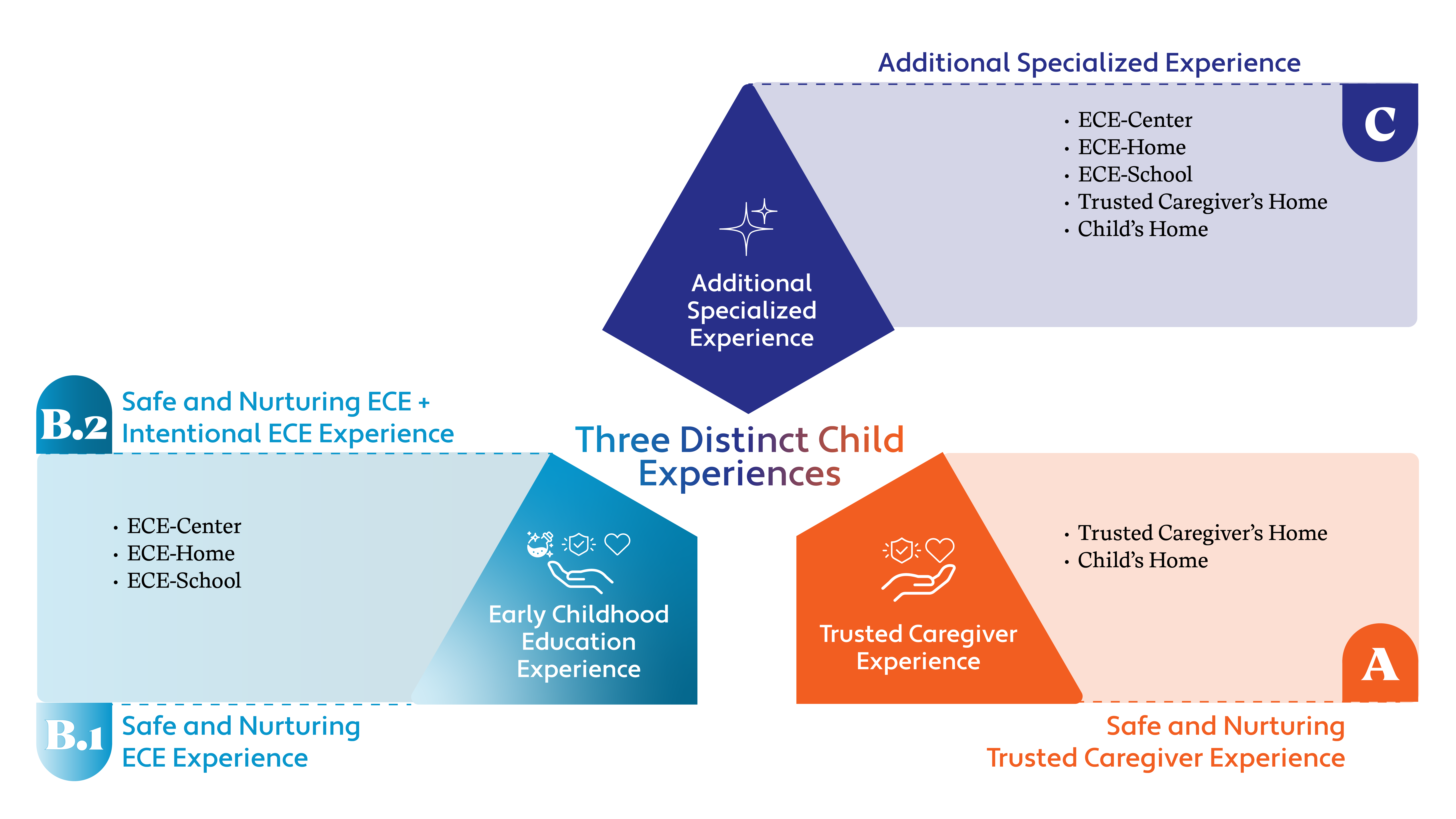
To create additional nuance, it is also important to look at these three distinct categories of child experiences when they are provided in a variety of supported settings. (See Figure 2.)
2. Purchase from a shared child care menu.
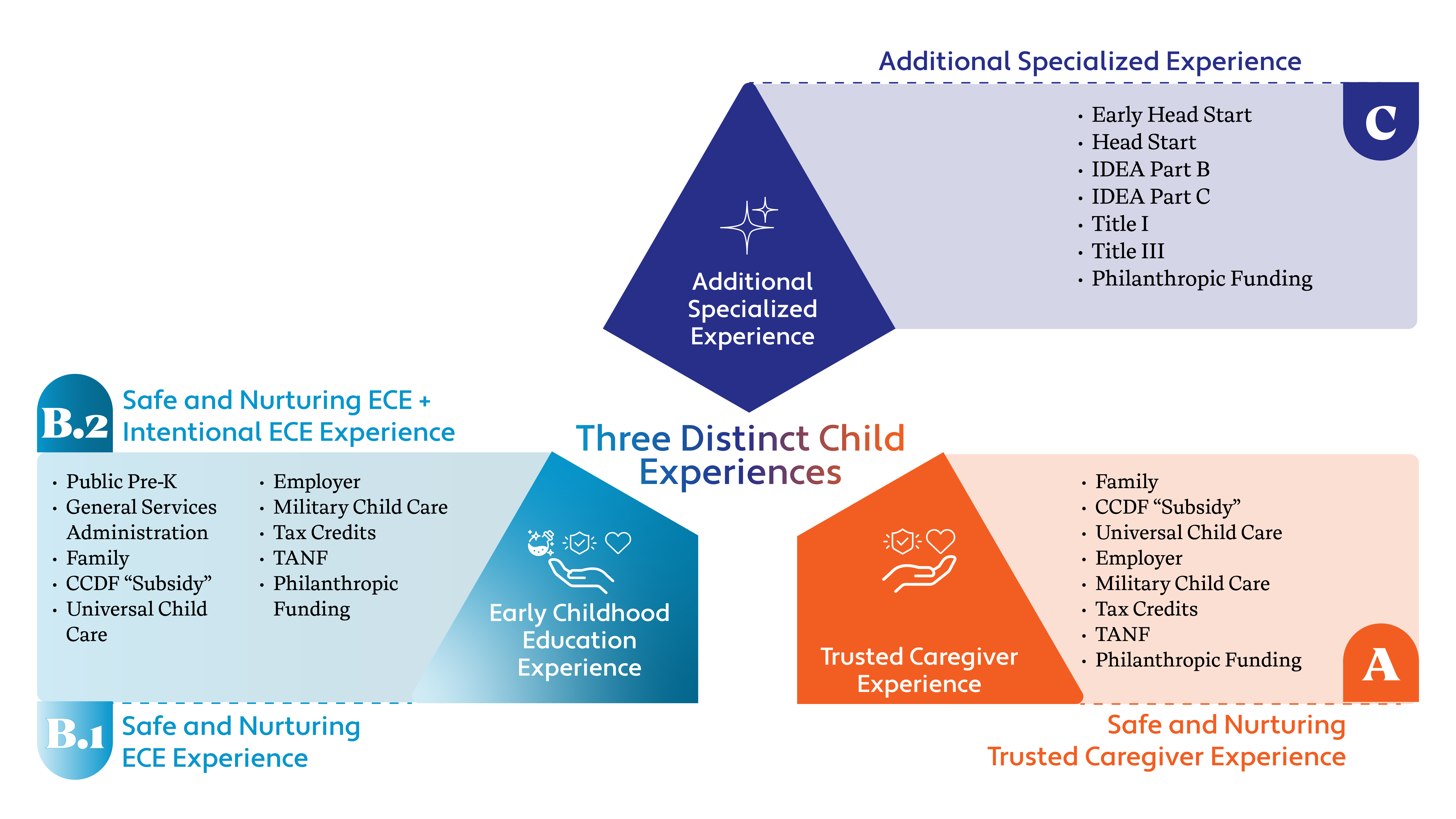
There will, most likely, always be multiple government payers helping families afford child care. Some may pay for all children or age groups (universal), others may focus on some children or age groups (targeted), and some may do both (universal and additional for targeted children).
There may be instances when multiple payers support the same site (different rooms or sets of children) or the same child (where payers split the day or year).
Families, employers, and philanthropy may also be payers. Here, we must consider:
- What if all payers use a shared menu to purchase the child experience that aligns with their intent, budget, and purpose?
- What if government payers ensure that families experiencing the most stressors had a fair chance to choose the child experience that would benefit their child the most?
Figure 3 depicts the use of a shared menu used to purchase various child experiences by all payers, both government and private.
3. Right-size regulations and reimbursements for each child experience category.
The cost of each child experience category varies because of what is required by the regulations for each experience. Adult:child ratios, materials, space requirements, and practitioner skill levels differ to ensure that children can consistently have the experiences that define each category and align with individual child and family needs.
Government regulations and reimbursements need to be right-sized because they shape the child care market. Investments in child care are less likely to have the intended impact or may worsen the child care crisis if reimbursement rates and regulations are incongruent. For example:
- Regulating B.1 as B.2 could force the B.1 market to go underground due to unfunded and overly burdensome regulations.
- Regulating A as B.2 could create a pushback that weakens the B.2 and B.1 child experiences because advocates protecting A from burdensome regulations may amplify the case for large-scale deregulation.
- Reimbursing B.2 at the B.1 rate could shrink the B.2 market or make the B.2 market a luxury experience that only high-income families can afford.
The critical questions to ask here are as follows:
- What if regulations for each child experience category are right-sized and align with what each child experience category requires?
- What if government payers purchase child care at a rate that is adequate to cover the cost of providing the child experience category being purchased?
Figure 4 conceptually depicts each child experience category with right-sized regulations and appropriate reimbursement or per pupil rates. The Additional Specialized Experience category is left blank because its regulations and reimbursements will be dependent on the services and programs chosen by the payer, whether it’s the government or the family.
The Future is Now
Sounds farfetched? The good news is that this future is already happening in bits and pieces in communities across the nation. The public narrative is shifting as lawmakers and business leaders prioritize child care. At WeVision EarlyEd, we are also testing, evaluating, iterating on, and refining this vision of a child-centered child care system with the WeVision EarlyEd Solutions Lab sites, early childhood policy experts, national and state advocates, and a cohort of researchers to move all of us closer to the ideal reality.
Each WeVision EarlyEd Solutions Lab site is focused on their child experience category. Lab sites are in a variety of settings, including ECE-Center, ECE-Home, a child’s home, and a Trusted Caregiver’s home. Regulations and costs are right-sized for WeVision EarlyEd Solutions Lab sites. Lab sites are leveraging multiple payers — including WeVision EarlyEd — to reduce or eliminate tuition for families. Rather than adding another set of quality regulations to the already overregulated sector, WeVision EarlyEd is leveraging and learning about existing industry-recognized standards. Most importantly, WeVision EarlyEd Lab Sites are helping to identify the cost of each category of child experience.
We invite the field to continue to shape the future of child care in ways that benefit young children and their families, as well as the professionals in the field, and the communities in which they all live.
Stay tuned for details on a webinar we will be hosting to spark in-depth dialogue about progress towards the ideal child care. In the meantime, we encourage you to send us an email with any insights, questions, or feedback you would like to share as we work together to make the ideal child care system real.