
Imagine this scenario:
A child care facility is licensed by a state agency. To help make care affordable, this facility serves families using federal child care subsidies, state-funded pre-K, military child care assistance, and Head Start funding. It is also nationally accredited to meet industry-recognized standards.
As a result, this facility must comply with at least six different sets of regulations, each with its own definition and measurement of quality and its own inspectors, creating overlapping oversight that can disrupt or diminish care for children. To make matters worse, reimbursement rates barely cover the cost of complying with these regulations.
This is the reality facing many child care facilities — both home- and center-based — across the country. In the end, families and young children bear the costs and impact of fragmented regulations and inadequate funding.
These challenges are not the result of any one program or policy. Rather, they stem from the lack of alignment across the systems that govern and fund child care. Recent proposed changes to Head Start regulations have placed renewed attention on how standards are set and oversight is structured across the sector. As the field considers how to preserve safety and accountability, this moment presents an opportunity to ask: How can the disjointed systems responsible for protecting children, supporting families, and stewarding public funds work together more coherently? Answering this question extends far beyond Head Start, requiring us to examine the early
childhood landscape as a whole.
Regulations and standards play an essential role in protecting children and ensuring responsible use of public resources. Yet the current landscape is shaped by a patchwork of funding streams, compliance requirements, and accountability mechanisms. Industry-led organizations operating accreditation, credentialing, and professional recognition systems add another layer of burden.
Together, these structures shape the experiences of young children, families, and educators. They also shape how child care, and the work of early childhood educators, are understood, valued, and priced.
Moving Beyond Defense Mode
Discussions about regulatory burden often center on defending specific rules, particularly as lawmakers consider making early childhood education or child care more affordable and accessible. But these debates also create an opportunity to examine the larger context in which those regulations operate.
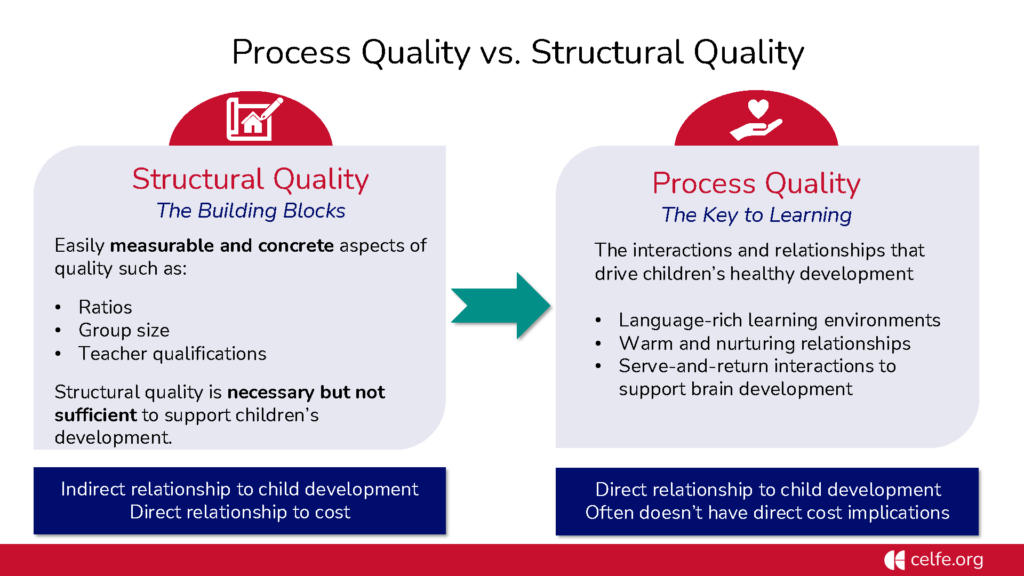
The Bainum Family Foundation supports efforts to protect critical safeguards, and that work remains essential. At the same time, through our WeVision EarlyEd initiative, we are studying the broader landscape of government regulatory systems and industry recognition systems. Early insights from WeVision EarlyEd Solutions Lab sites (which are implementing and testing child care innovations across the country) have prompted us to examine more closely how regulations, per-child costs, and various funding streams are interdependent on one another. Requirements vary considerably across systems; not all are easily measured or have significant cost implications.
Insights From Regulatory and Recognition Systems Experts
To better understand these challenges and identify opportunities for greater coherence, we recently convened more than 60 experts from across the country to examine how child care regulations, funding streams, and accountability structures can work together more effectively. Participants included government agency leaders from eight states, representatives from 12 industry credentialing and accreditation organizations, and 13 experts from policy and research organizations. Together, they were asked to:
- Assess the current landscape from the perspective of the practitioners and child care business owners implementing the regulations, noting gaps and overlaps.
- Look beyond today’s fragmented structures and inadequate funding streams to consider what a more effective system could achieve.
- Explore what it would take to create a more coherent regulatory ecosystem, designed around a shared menu of clear and funded child care options.
What Regulatory Coherence Requires
The conversations quickly revealed that achieving regulatory coherence requires far more than tweaking federal and state rules. Participants explored the need for role clarity between government regulations and industry recognition systems along with a shared lexicon. They also examined issues such as professional autonomy, states’ rights, funding adequacy, universal recognition, and interstate professional licensure compacts. Drawing on lessons from other sectors that have developed stronger regulatory coherence over time, participants also considered what could be possible for child care.
Underneath these very technical topics were fundamental questions about scope and responsibility:
- What must the government oversee to protect children and ensure accountability for public funding? What is adequate and what is overreach?
- Who regulates settings, who regulates practitioners as individuals, and how do these functions interact?
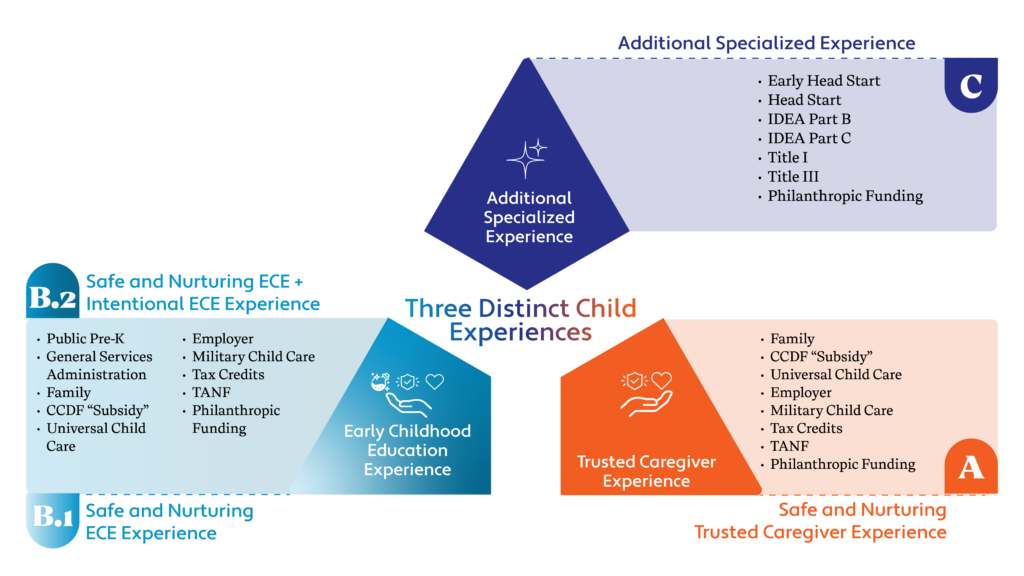
- Which entities, if any, regulate “trusted caregivers?”
- Where might industry systems like accreditation and credentialing be better positioned to maximize public funding and create cohesion?
- Where is there opportunity for regulatory reciprocity and “deemed status?”
- And importantly, how do we ensure that expectations are aligned to adequate funding?
The conversations also highlighted a reality that may be even harder to address than technical design. Coherence requires people, government, and institutions to behave differently. Participants identified trust, shared decision-making, and a willingness to relinquish some decision-making power as necessary ingredients for change.
That may be one of the hardest parts of this work. Creating a more coherent system requires government regulatory and industry recognition systems to ask not only, “What should we be responsible for?” but also, “What might another part of the system be better positioned to do?”
Making Regulatory Coherence Real
Building on these conversations, participants moved from ideating the abstract to pressure testing a tangible model.
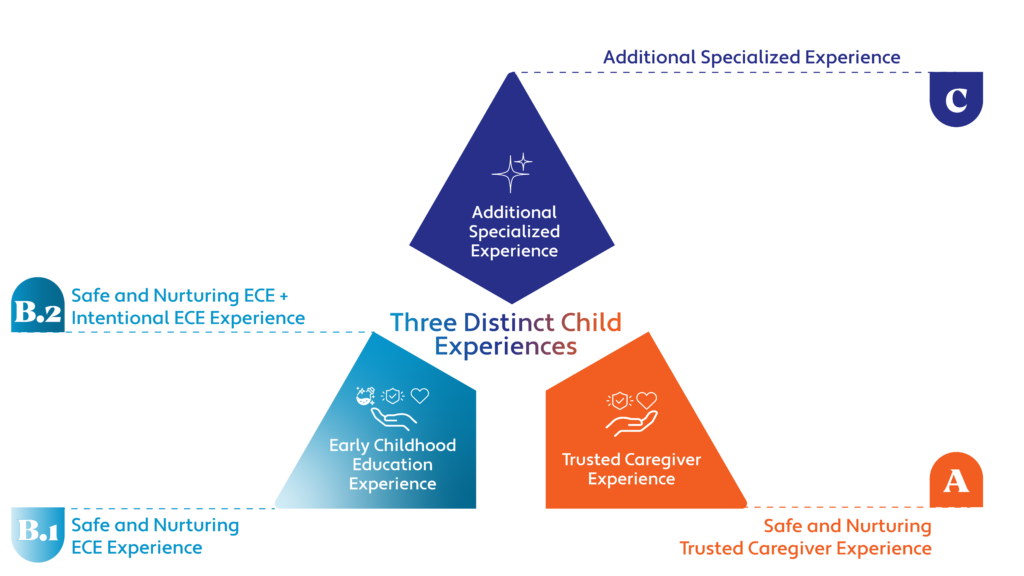
Using this mock WeVision EarlyEd regulatory coherence framework, government regulatory and industry recognition systems experts were placed in new and sometimes more restricted roles. Identifying as either settings-focused or practitioner-focused, they used common reference points that were detached from specific government funding streams. Regulating “trusted caregivers” was excluded from this framework and presented as out-of-scope for participants. The exercise intentionally disrupted familiar ways of working.
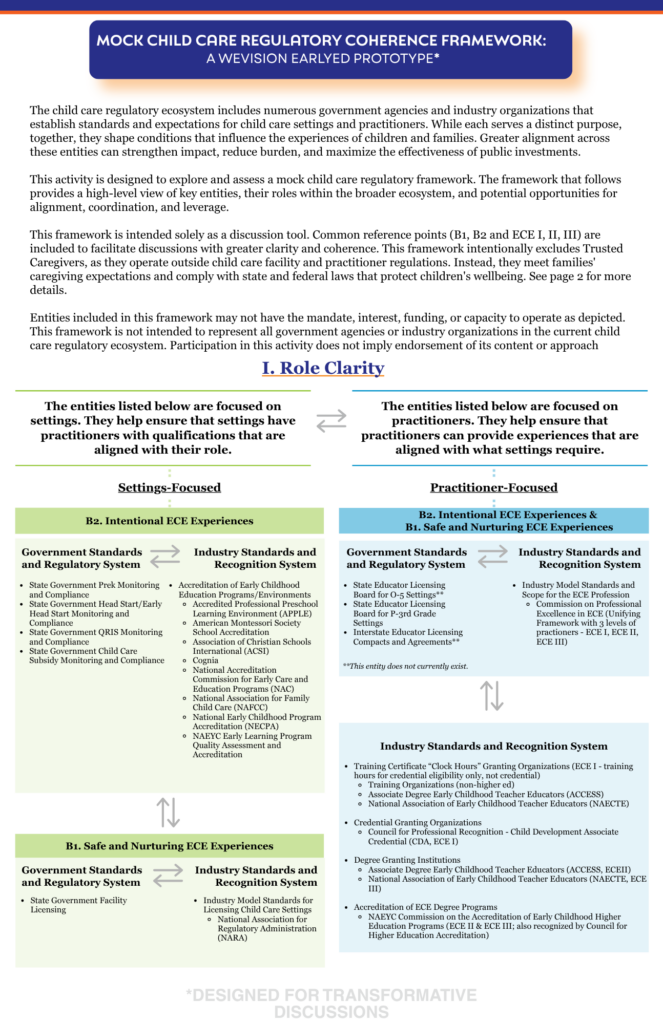
The goal was not to identify a single solution, but to understand what becomes possible when leaders across systems work together to design around shared outcomes. Throughout the discussions and exercises, we heard courageous ideas about what could change, cautionary perspectives about what must be protected, and complementary approaches for how different systems might work together.
When asked to select the most valuable part of the event, the majority of participants (71%) selected discussing the regulatory framework and dedicating time to think about future systems change.
Protecting What Matters While Reimagining What’s Possible
The child care or early childhood education sector, government regulatory systems staff, and industry recognition systems staff must do two things at once — navigate the systems that exist today while simultaneously improving them. This includes responding thoughtfully when proposed regulatory changes may affect important protections for children, families, and practitioners.
But we also need space to look beyond the confines of today’s system.
The Child Care Regulatory Coherence Convening reinforced that transformative conversations are possible when leaders have the opportunity to step outside their institutional roles, question long-standing assumptions, and imagine how responsibility could be shared differently.
A more coherent regulatory ecosystem will not emerge from a single convening. However, the leadership and ideas shared in the room demonstrated that meaningful change is both possible and necessary. If we are willing to rethink roles, build trust across institutions, and align expectations with funding, we can protect what matters today while creating a stronger system for the future.
"It's so important for this field to have a vision for the future and not just be reacting to current policy changes, but we can't do it alone and we can't do it without the time and resources necessary. I so appreciate these convenings for taking me out of the ‘day to day’ and putting me in a space to think deeply with other leaders."
—Event Survey Respondent
The Bainum Family Foundation, through its WeVision EarlyEd initiative, remains committed to providing the time, tools, and space to shape the future of child care in ways that benefit young children and their families, the professionals in the field, and the communities in which they all live.
We encourage you to share your insights, questions, and feedback as we work together to make the ideal child care system real.